Loading...

Personality Types

All you need to know about your personality type, how it is calculated & how our Framework is constructed

Understanding the Basics of this test

Myers - Briggs Test Indicator
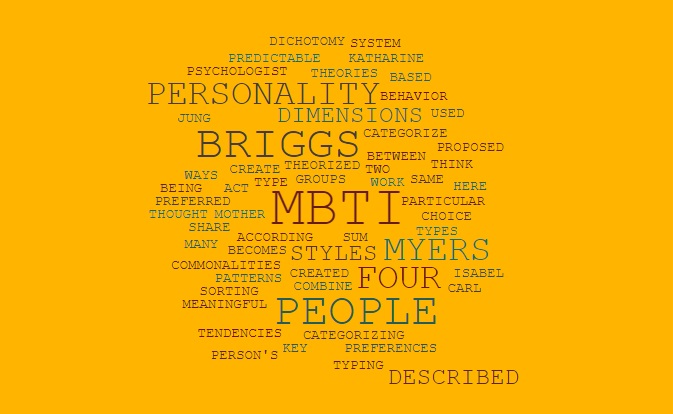
Introduction to personality types and the Myers-Briggs framework

Personality typing is a system of categorizing people according to their tendencies to think and act in particular ways, sorting people into meaningful groups.

The personality types described here were created by Isabel Briggs Myers and her mother, Katharine Briggs, in the 1960s.

Their theories were based on the work of psychologist Carl Jung.

Personality assessment and typing concepts

Myers and Briggs proposed that there were four key dimensions described as a dichotomy, or an either/or choice between two styles of being that could be used to categorize people.

The sum of a person's four preferred styles becomes their personality type.

Myers and Briggs theorized these dimensions would combine to create predictable patterns in thought and behavior so that people with the same four preferences would share many commonalities.


Four Dichotomy of Personality

Introversion and extraversion — how people manage energy

I/E - Introversion or Extraversion

How a person manages their energy.

  • Introverts spend quiet time alone or with a small group. They tend to be more reserved and thoughtful.
  • Extraverts spend time with people and in busy, active surroundings. They tend to be more expressive and outspoken.
Sensing and intuition — how people process information

S/N - Sensing or INtuition

How an individual processes information.

  • Sensors focus on their senses & are interested in them. They tend to be hands-on learners and are called as "practical."
  • Intuitives focus on abstract level thinking - theories, hypothesis. They tend to be concerned more with the future and called as "creative."
Thinking and feeling — how people make decisions

T/F - Thinking or Feeling

Describes how people make decisions.

  • Thinkers tend to make decisions with their heads. they are interested in finding the most logical, reasonable choice.
  • Feelers tend to make decisions with their hearts. they are interested in how a decision will affect people, and whether it fits in with their values.
Judging and perceiving — how people approach structure

J/P - Judging or Perceiving

How people approach to structure in their lives.

  • Judgers appreciate structure and order. They like things planned, and dislike last-minute changes.
  • Perceivers appreciate flexibility and spontaneity. They like to leave things open so they can change their minds.

Four Categories of Personality

Diagram of the four personality categories: Analysts, Diplomats, Sentinels, and Explorers
analyst

analyst

[ _NT_ ] View
diplomats

diplomats

[ _NF_ ] View
sentinels

sentinels

[ _S_J ] View
explorers

explorers

[ _S_P ] View

Frequently Asked Questions About Personality Types

Quick answers designed for search and AI assistants.

What are the four personality categories?

MakeChoice groups all 16 personality types into Analysts, Diplomats, Sentinels, and Explorers based on shared preference patterns.

How is personality type calculated?

Your type is based on four dichotomies: Introversion/Extraversion, Sensing/Intuition, Thinking/Feeling, and Judging/Perceiving.

Can personality type change over time?

Your core preferences are often stable, but behavior can shift with experience, role demands, and life context.

How should I use personality insights?

Use personality insights to improve self-awareness, communication, relationships, and career decisions rather than as rigid labels.